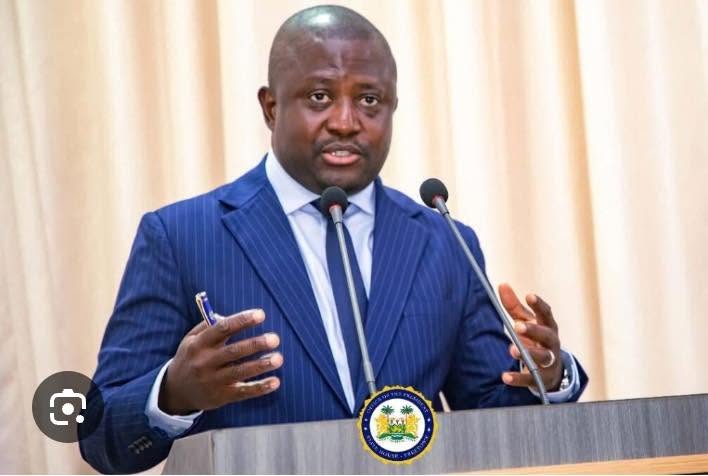
The Attorney General and Minister of Justice, Alpha Sesay Esq., has intervened in the ongoing governance crisis engulfing the Sierra Leone Bar Association (SLBA), stating in no uncertain terms that the current Executive no longer possesses the authority to indefinitely postpone the Annual General Meeting (AGM).
In a strongly-worded letter addresses to the President of the SLBA dated 2nd June 2026, the Attorney-General noted that the Executive assumed office on 17th May 2024 and that its constitutionally prescribed two-year mandate expired on 17th May 2026.
The AG’s intervention comes following growing tensions within the SLBA after its Executive announced the indefinite postponement of the Association’s AGM, a decision that reportedly sparked outrage among members who viewed it as an attempt to extend the leadership’s tenure beyond its legal mandate.
While acknowledging that existing provisions allow the President to remain in office until a successor is elected, the AG emphasised that such provisions are intended solely to ensure continuity and cannot be interpreted as granting indefinite authority to remain in office or make major governance decisions.
Alpha Sesay Esq. stressed that the Executive is now operating only in a caretaker capacity and is restricted to routine administrative functions.
The AG further challenged the legality of the Executive’s decision to postpone the AGM indefinitely. He cited Section 185 (1) of the Companies Act 2009 to remind the Association that the AGM must be held at least once every year and that no more than fifteen months should elapse between such meetings.
According to him, an indefinite postponement effectively amounts to the cancellation of the AGM and constitutes a breach of statutory obligations, arguing that the current Executive lacks the legal authority to alter governance arrangements, extends its mandate, or make binding decisions on behalf of members without proper constitutional or judicial authority.
Many legal luminaries nationwide have applauded the AG’s firm stance, describing his actions as a necessary step to end what many have characterised as the unjust domination of the Association by a small group of individuals.
According to several members of the Bar, the intervention was long overdue and serves to protect the integrity, democratic principles, and constitutional governance of the legal profession.
About the Author