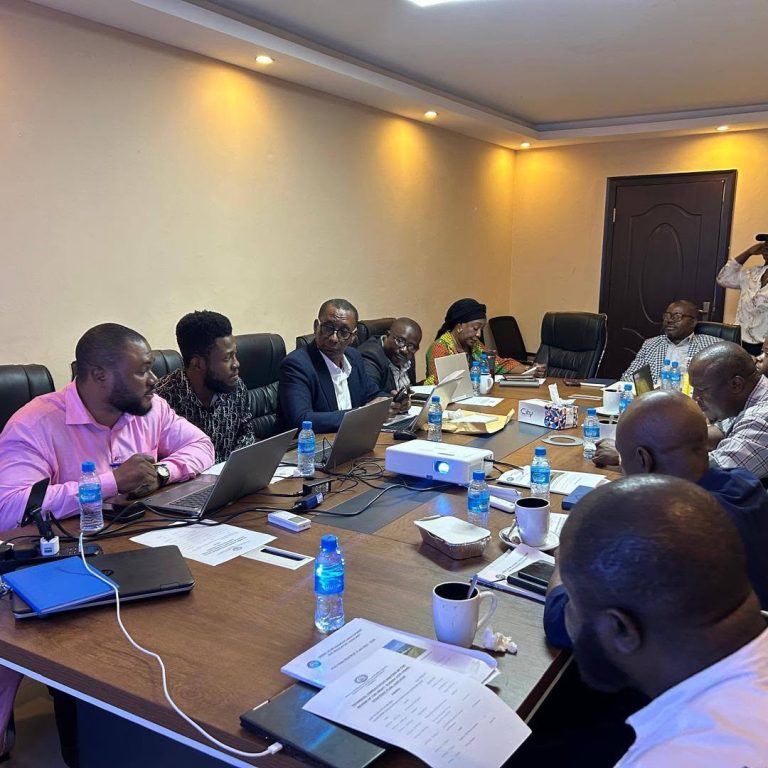

The Sierra Leone Railways Development and Regulatory Authority (SLRDRA) convened a high-level Stakeholders’ Consultative Meeting at the New Brookfield’s Hotel, Freetown, bringing together Government officials, representatives of Ministries, Departments and Agencies (MDAs), development partners, technical experts, and private sector stakeholders to commence the process of developing Sierra Leone’s first National Railway Master Plan.

The consultative meeting marked a significant milestone in the Government’s efforts to reintroduce a national railway system, as part of its broader agenda to improve transportation infrastructure, stimulate economic growth, and strengthen regional connectivity.
The meeting was moderated by The Company Secretary of SLRDRA, Ms. Umu Nyalay Gbappy ESQ, who welcomed participants and emphasized the importance of institutional coordination, transparency, accountability, and stakeholder ownership throughout the development of the Master Plan development process.
She stated that the Authority remains committed to maintaining strong partnerships with Government institutions and development partners to ensure the successful implementation of the railway development agenda. In delivering the welcome address, the Deputy Director-General of the Sierra Leone Railways Development and Regulatory Authority, Mr. George Simeon Songu, expressed appreciation to the Honourable Deputy Minister of Transport and Aviation, representatives of Government institutions, development partners, the Local consultant, ARIES Engineering and Consulting Services, and all stakeholders for honoring the invitation.

He described the meeting as a historic occasion that demonstrates Sierra Leone’s collective commitment to restoring a railway system capable of supporting national development and economic transformation.
In his opening remarks, the Chairman of the Board of Directors of SLRDRA, Mr. Mohamed Tejan-Kella, welcomed participants and emphasized the importance of developing a strategic roadmap for the revival of railway transportation in Sierra Leone. He noted that the National Railway Master Plan will identify priority railway corridors and establish a framework for the phased development of railway infrastructure across the country. According to the Chairman, a functional railway network will contribute significantly to economic growth by facilitating trade, improving access to markets, reducing transportation costs, supporting industrialization, and promoting regional integration.
Mr. Tejan-Kella further highlighted the importance of ensuring that railway development is aligned with national development priorities and international best practices. He urged stakeholders to remain fully engaged throughout the planning process and contribute towards building a sustainable railway sector capable of supporting Sierra Leone’s long-term development goals.
Delivering the keynote address, the Honourable Deputy Minister of Transport and Aviation, Mr. Rex Bonapha reaffirmed Government’s commitment to restoring Sierra Leone’s railway sector in line with the vision of His Excellency President Dr. Julius Maada Bio. The Deputy Minister reflected on the historical significance of Sierra Leone’s railway system and noted that the country once possessed an extensive railway network that played a vital role in connecting communities and supporting economic activities.He further stated that the reintroduction of railway transportation has become increasingly necessary as Sierra Leone seeks to improve connectivity, facilitate trade, support mining and agricultural production, create jobs, and attract investment.
Mr. Bonapha emphasized that railway development remains a strategic priority for Government because of its potential to transform the movement of passengers and freight throughout the country.He outlined Government’s two-phase railway investment strategy. The first phase involves the preparation of a comprehensive National Railway Master Plan supported by technical, economic, financial, environmental, and social feasibility studies.
The second phase will focus on attracting private sector investment and development partners to finance and implement viable railway corridors identified through the studies.According to the Deputy Minister, he informed participants that the procurement process for an internationally reputable engineering consulting firm to undertake the detailed studies was in its final stages.He called upon all Ministries, Departments and Agencies to provide relevant information and technical data required for the successful preparation of the Master Plan.
The Director General of SLRDRA, Ing. Dr. Albert Forde, delivered a comprehensive presentation on the proposed National Railway Network and the vision for railway development in Sierra Leone. He explained that the proposed network consists of fourteen interconnected railway corridors covering approximately 1,900 kilometers across the country, with opportunities for future connections to neighboring countries under the ECOWAS regional integration programme.The Director General noted that the proposed railway network is designed to support four major growth poles that would drive railway demand and investment namely agriculture, mining, trade and investment, and passenger and tourism transportation.
He highlighted plans for a future commuter rail service connecting Waterloo to River Number Two as part of efforts to improve urban mobility and support tourism development. Ing. Dr. Forde emphasized that the development of the railway network would be guided by detailed feasibility studies, economic and financial analyses, environmental and social assessments, and stakeholder consultations.
He stated that the proposed railway system would complement existing transport modes and contribute to the efficient movement of goods and passengers throughout the country.The Director General further explained that the Authority is committed to adopting modern railway technologies and environmentally sustainable solutions capable of supporting future economic expansion.
Presenting the National Railway Master Plan Framework, Ing. Hassan Tamimu outlined the objectives, methodology, and expected outcomes of the railway development study.He explained that the Master Plan is intended to establish a strategic framework for the long-term development of railway infrastructure in Sierra Leone while supporting economic growth, trade facilitation, regional integration, and national connectivity.
Ing. Tamimu highlighted the importance of undertaking comprehensive data collection from key Government institutions and stakeholders to inform the planning process. He noted that the study will review existing information, identify passenger and freight demand patterns, conduct preliminary technical assessments, and undertake environmental screening of proposed railway corridors.
Representing ARIES Engineering and Consulting Services, Ing. Nappy Bah delivered a presentation on the proposed railway route options and corridor development strategy. She explained that the preliminary route assessment was undertaken to identify railway corridors capable of supporting national economic development while meeting international engineering standards.
According to Ing. Bah, the route selection process considered factors such as population distribution, economic activity, mining operations, agricultural production centres, topography, environmental conditions, and future growth potential.She noted that the proposed railway corridors are intended to improve access between major economic centres, industrial zones, agricultural regions, mining communities, and maritime facilities.
Ing. Kallon of SLRDRA delivered a technical presentation focusing on engineering standards, railway design principles, and implementation considerations for the proposed railway network. He emphasized the importance of adopting modern railway engineering practices that comply with international and ECOWAS standards. According to Ing. Kallon, the proposed railway system will require detailed surveys, alignment studies, bridge assessments, geotechnical investigations, hydrological studies, and environmental evaluations to ensure safe and sustainable construction.
The vote of thanks was delivered by Ing. Fatmata Halima Turay, who expressed appreciation to the Honorable President of Sierra Leone, the Deputy Minister of Transport and Aviation, Board Chairman, Director General, representatives of MDAs, development partners, ARIES Engineering and Consulting Services, and all stakeholders for their active participation and valuable contribution.
She commended the collaborative spirit demonstrated throughout the consultation and encouraged continued cooperation as SLRDRA advances the development of Sierra Leone’s first National Railway Master Plan.
The consultative meeting concluded with a renewed commitment by Government, SLRDRA, and technical partners to work collaboratively towards the successful development of Sierra Leone’s first National Railway Master Plan.
The initiative is expected to lay the foundation for the restoration of railway transportation in Sierra Leone, improve national connectivity, facilitate trade and investment, create employment opportunities, and contribute significantly to the country’s long-term economic transformation.
Credit: Mariama Iyatunde Mansare, Public Relations Officer
About the Author